unlocking trapped assets

Introducing CLPR: the bridgeless Cross-Ledger Protocol

CLPR (“clipper”) is a new bridgeless Cross-Ledger Protocol developed by Hashgraph that enables cryptographically-secured communication and token transfers between independent blockchain networks–all without bridges, pooled liquidity or intermediary validator networks.

the walled garden problem

Inter-ledger interoperability challenges in blockchain

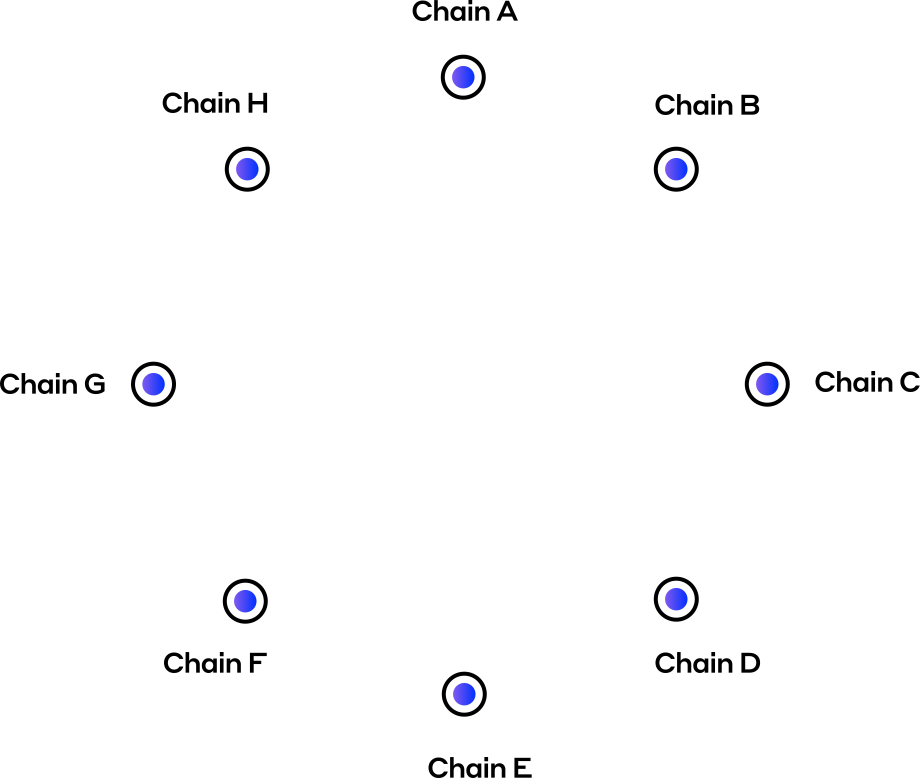
One of the most fundamental structural problems in the blockchain ecosystem is the fragmentation of liquidity across isolated networks. Each blockchain network operates as its own sovereign ledger with its own consensus rules, token standards, and execution environments. Assets native to one chain simply cannot ‘understand’ or interact with another chain natively. Bridges and relayers have emerged as ‘workarounds’, but they introduce centralization and security vulnerabilities.


inter-connected web of networks

A unified, interoperable financial system 

CLPR (Cross-Ledger Protocol) enables tokens, data, and messages to move freely across networks, secured by cryptographic state proofs and threshold signature schemes (TSS), without relying on a third party in between. Trust is established between the two ledgers. There are no honeypots, no operators who can redirect funds, and no single point of failure that attackers can exploit.

Unlock new sources of liquidity

CLPR enables assets from any chain to flow into and out of HashSphere networks, and the Hedera network to drive liquidity so Islands of ‘trapped assets’ can be a thing of the past.

Fast and secure

Traditional bridges introduce intermediary trust points whose compromise can result in total loss of funds. CLPR establishes trust directly ledger-to-ledger using state proofs. Because it eliminates single points of failure, and preserves each chain’s native consensus model, security assumptions are not weakened, and transfers complete as fast as the underlying networks reach consensus.

Scalable and simple implementation

By removing complex trust models, costly integrations and bridge liquidity requirements, CLPR provides a secure, scalable, and low-cost mechanism for inter-ledger communication.


PUT CAPITAL TO WORK ACROSS NETWORKS

Delivering interoperability between HashSphere networks and Hedera

CLPR was designed to enable interoperability between HashSphere private networks and the Hedera public network, including Sphere-to-Sphere and Sphere-to Hedera transfers. Because HashSphere networks are aBFT by design and powered by Hedera technology, inter-Sphere transfers can achieve some of the fastest cross-ledger settlement times available anywhere in the blockchain ecosystem.


CHAIN-AGNOSTIC

Solving the liquidity fragmentation problem
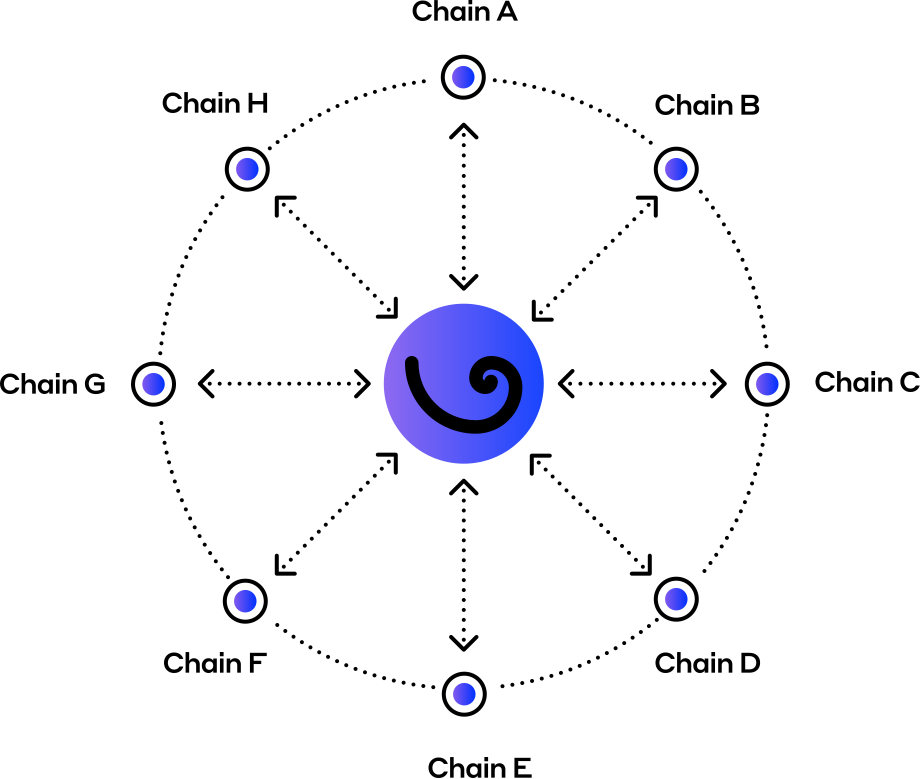
The CLPR protocol is designed to be chain-agnostic and support major EVM-compatible networks, including Ethereum, Hyperledger Besu and Avalanche subnets. Any network that can produce or verify state proofs is a candidate for CLPR, regardless of whether it is a public or private network.


two step process

CLPR enables secure asset transfer without intermediaries

In Step 1, each ledger runs CLPR endpoints (dedicated servers that communicate directly with their counterparts on the other ledger) exchanging proofs to verify and settle transfers. These endpoints hold zero custody of assets at any point. If an endpoint goes offline, any party, including the sender, can resume a paused transfer by submitting the required proof directly.

In Step 2, once both ledgers have implemented CLPR natively, the validators themselves become the endpoints. Each ledger verifies the other’s state using its own native proof mechanism, with no separate infrastructure or intermediary of any kind required.


See the Cross-Ledger Protocol in action

The postmaster analogy captures CLPR’s design philosophy. A postmaster routes your letter from one place to another but never reads it, alters its contents, or keeps your money. CLPR routes value and data between ledgers according to cryptographically enforced rules without ever taking custody of what is being transferred. Transfers are initiated and completed through smart contract invocations on each ledger, requiring no permission from the destination chain’s governance.


Data, messages and token transfers

CLPR is designed as a general-purpose inter-ledger communication layer, not just a mechanism for moving tokens. The same infrastructure supports cross-ledger data messaging and oracle workflows, enabling consistent, tamper-resistant data feeds across multiple networks. This opens up application architectures that simply aren’t possible with token-only bridges.


Get involved

CLPR is currently in closed beta. Hashgraph is inviting a select group of institutions to join the Early Adopter Program, and have a unique opportunity to help shape the protocol before it formally launches to market.